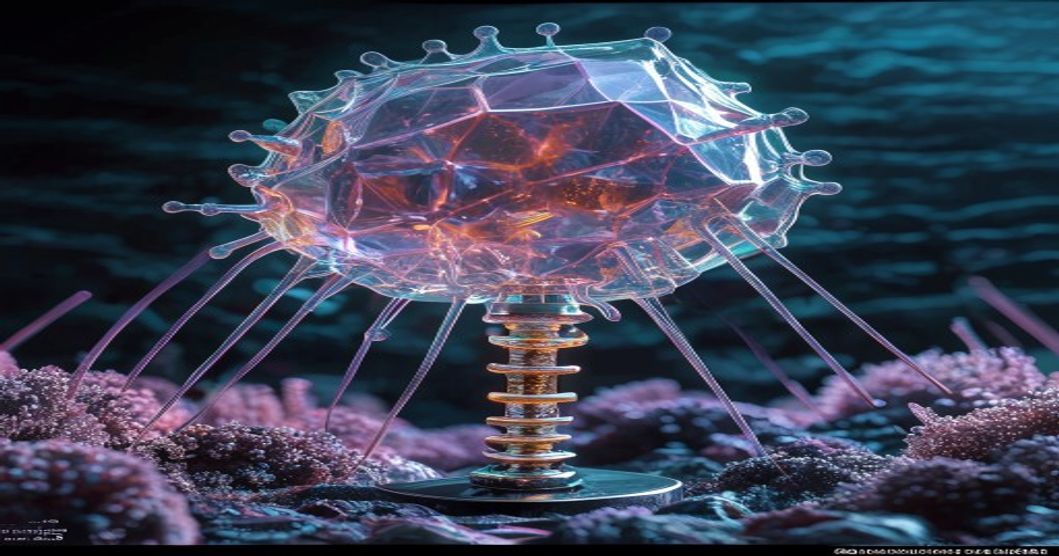
The global healthcare infrastructure is currently facing a "silent" production outage. It’s not a DDoS attack on a CDN or a database deadlock in a regional data center. It is Antimicrobial Resistance (AMR). For decades, we have relied on antibiotics—broad-spectrum biological "kill -9" commands—to manage bacterial infections. But the bugs have evolved. They’ve developed sophisticated error-handling routines, efflux pumps, and horizontal gene transfer protocols that render our most powerful tools useless.
By 2050, AMR is projected to cause 10 million deaths annually. In engineering terms, our primary security patch is no longer compatible with the evolving threat landscape.
At the intersection of synthetic biology and high-performance computing, a new architecture is emerging: Synthetic Virome Design. We are moving away from "analog" phage therapy (finding a virus in a sewer and hoping it works) toward a full-stack engineering approach. We are treating the bacteriophage—the natural predator of bacteria—as a programmable, modular hardware-software stack.
This post dives deep into how we’re building the infrastructure to design, simulate, and boot synthetic phages to remediate AMR and manipulate the human microbiome with surgical precision.
The Biological Stack: Phages as Programmable Nano-Machines
To understand synthetic virome design, you have to look at a bacteriophage not as a "creature," but as a highly optimized delivery vehicle for genomic code. A typical T4 phage is a marvel of mechanical engineering:
- The Capsid (Storage): A protein shell protecting the DNA/RNA payload.
- The Tail Fibers (Network Interface): Highly specific sensors that recognize receptors on the surface of a target bacterium.
- The Baseplate (Handshake Protocol): Once the tail fibers bind, the baseplate initiates a conformational change.
- The Sheath (Execution): A spring-loaded mechanism that punctures the bacterial membrane and injects the genomic payload.
In the old world, we hunted for these in nature. In the new world, we write the source code.
The Hype vs. The Reality: Why Now?
Phage therapy has been "the next big thing" for a century. Why did it fail to scale? Historically, phages were too specific (they’d kill one strain of E. coli but not another) and they were "black boxes." You couldn't easily predict if a phage would undergo a lytic cycle (killing the host) or a lysogenic cycle (integrating into the host genome and staying dormant).
The sudden "hype" jump in 2024 is driven by three technological convergences:
- Massively Parallel DNA Synthesis: We can now print 100kb genomes with high fidelity for the cost of a mid-range GPU.
- Protein Language Models (pLMs): Tools like ESM-2 and AlphaFold 3 allow us to design "de novo" tail fibers that have never existed in nature.
- CRISPR-Cas Infrastructure: We can now use phages as "Trojan Horses" to deliver CRISPR payloads that specifically snip out antibiotic-resistance genes without killing the beneficial bacteria.
Engineering the Pipeline: From Metagenomics to Synthetic Booting
Building a synthetic virome isn't just about biology; it’s a massive data engineering challenge. Our pipeline looks remarkably like a modern CI/CD (Continuous Integration/Continuous Deployment) workflow.
1. The Ingest Layer: Metagenomic Mining
The Earth contains an estimated $10^{31}$ phages. That is the ultimate training set. We use high-throughput sequencing to "scrape" environmental samples. The raw data—petabytes of short-read and long-read sequences—is processed through a pipeline to identify Viral Contigs.
We aren't just looking for whole viruses; we are looking for functional modules.
- Lysis modules: The "code" that dissolves cell walls.
- Host-recognition modules: The "APIs" for bacterial surface proteins.
2. The Design Environment (The Bio-IDE)
Once we have a library of modules, we use a design DSL (Domain Specific Language) to assemble a synthetic genome. Imagine a YAML configuration for a virus:
version: "3.2"
phage_id: "SYN-AMR-ECOLI-004"
chassis: "T7-Lambda-Hybrid"
components:
    capsid:
        type: "icosahedral-T7"
        capacity: "40kb"
    targeting_system:
        tail_fibers: "K1-F-Type"
        receptor_affinity: "O-antigen-Ecoli-K1"
        optimization: "GPU-Folded-DeNovo-V3"
    payload:
        - type: "lytic-cascade"
          enzymes: ["endolysin-lysK", "holin-GH"]
        - type: "crispr-payload"
          target_gene: "NDM-1" # The New Delhi metallo-beta-lactamase gene (AMR)
          spacer_sequence: "ATCGG...GCTA"
3. Simulating the Handshake
Before we print the DNA, we run a "Digital Twin" simulation. The most critical part of a phage is the interaction between the Tail Fiber Protein (TFP) and the bacterial LPS (Lipopolysaccharide).
We use Graph Neural Networks (GNNs) to predict the binding affinity. If the predicted $K_d$ (dissociation constant) is too high, the "build" fails. We iterate on the protein sequence until we get sub-nanomolar affinity for the target pathogen.
The Infrastructure of "Booting" a Virus
How do you turn a .fasta file on a server into a living, replicating virus? This is the Synthetic Booting phase, and it is the closest thing we have to "downloading" hardware.
Cell-Free Protein Synthesis (CFPS)
Traditionally, you’d transform a bacterium with your synthetic DNA and hope it produces the virus. But if your virus is designed to kill that bacterium, your "build machine" crashes mid-compile.
To solve this, we use Cell-Free systems. We take the internal machinery of a cell (ribosomes, tRNAs, polymerases), put them in a test tube, and add our synthetic DNA. The system starts transcribing and translating. Within hours, the proteins self-assemble into complete viral particles.
This is the biological equivalent of a serverless function. You provide the code; the environment provides the execution, and you get an output (the phage) without managing the underlying "cellular" instance.
Precision Microbiome Manipulation: Moving Beyond "Nuke Everything"
Broad-spectrum antibiotics are the biological equivalent of running rm -rf / to fix a configuration error in /etc/hosts. It works, but the system is broken afterward.
In the human gut, the "Good Bugs" (Bifidobacterium, Lactobacillus) provide essential services: neurotransmitter production, immune training, and vitamin synthesis. When you take a 10-day course of Ciprofloxacin, you are causing a massive system outage.
Synthetic Viromes enable "Surgical Deletion."
By engineering phages to target only specific pathobionts (like Clostridioides difficile or inflammatory E. coli strains associated with IBD), we can "debug" the microbiome without affecting the rest of the stack.
Remediation of AMR at Scale
The most exciting application is Re-Sensitizing bacteria. Instead of killing the bacteria, we design "Non-Lytic" phages that act as gene-editing delivery vehicles.
- Deployment: A synthetic virome is introduced into a wastewater system or a patient's gut.
- Infection: The phages infect bacteria carrying AMR genes (like the blaZ or mecA genes in MRSA).
- Execution: Instead of lysing the cell, the phage delivers a CRISPR-Cas system that specifically cuts the plasmid containing the resistance gene.
- Result: The bacteria survive but are now "patched." They are once again susceptible to standard, cheap antibiotics. This effectively "rolls back" the evolution of resistance.
The Compute Scale: Why Biologists are becoming Cloud Architects
The bottleneck in synthetic virome design is no longer the wet lab—it’s the compute.
Genomic Search and Alignment
Comparing a single metagenomic sample against the NCBI "nt" database is a computationally expensive task. We are moving from BLAST (Local Alignment Search Tool) to Vector Databases. By embedding genomic sequences into high-dimensional vector space using Large Language Models (LLMs) trained on DNA, we can perform "semantic" searches for viral functions.
Instead of searching for a specific sequence of A, T, C, and G, we search for: "Find me all sequences that structurally look like a Class II Holin but are optimized for high-salinity environments."
Protein Folding and Design
Simulating the dynamics of a phage tail fiber involves modeling thousands of atoms over microsecond timescales.
- AlphaFold-Multimer runs on clusters of A100/H100 GPUs to predict how the phage baseplate interacts with bacterial receptors.
- ProteinMPNN is used to "back-design" the amino acid sequence that will fold into that specific shape.
A single "design sprint" for a new synthetic virome can consume tens of thousands of GPU hours. We are seeing the rise of Bio-Ops, where Kubernetes clusters are orchestrated to handle sudden bursts of folding simulations.
Infrastructure Curiosities: The "Air-Gapped" Bioreactor
When engineering at this level, security is paramount. We aren't just worried about "bugs" in the code; we’re worried about Biosecurity.
The industry is adopting a "Zero Trust" architecture for DNA synthesis. Before a sequence is sent to a physical printer, it must pass through an automated screening layer:
- The "Redline" Check: Does this sequence code for a known human pathogen (e.g., Ebola, Smallpox)?
- The "Function-of-Concern" Check: Does this sequence introduce enhanced virulence or environmental stability?
The bioreactors where these phages are scaled up are essentially Air-Gapped Data Centers. They are equipped with HEPA-filtration, negative pressure, and real-time DNA-sequencing "canaries" that monitor the exhaust for any leaked synthetic material.
The Road Ahead: Deploying "Software Updates" to the Gut
The ultimate goal of Synthetic Virome Design is to treat the microbiome as a managed service.
Imagine a future where you have an "Observation Layer" for your health—perhaps a smart toilet or a wearable biosensor—that detects a spike in a specific inflammatory bacterial strain. Instead of a doctor prescribing a broad antibiotic, a cloud-based bio-foundry generates a tailored synthetic virome patch.
Within 24 hours, you receive a shelf-stable, encapsulated phage cocktail. This cocktail is a "one-off" execution: it enters the gut, replicates as long as the target pathogen is present, and then, once the "bug" is fixed, the phages naturally degrade as they have no more hosts to infect.
It is the ultimate "Ephemeral Environment."
Scaling the Remediation
To solve AMR globally, we need to deploy this at scale in our environment—not just in humans. We are looking at "Engineered Virome Buffers" for hospital wastewater and agricultural runoff. By neutralizing resistance genes before they enter the general environment, we can stop the spread of AMR at the source.
We are moving from an era of "Discovery" to an era of "Design." The microbiome is no longer a mysterious wilderness; it is a complex, high-concurrency system that we are finally learning how to debug.
The code of life is written in DNA. It’s time we started using a better compiler.
Technical Footnotes & Engineering Considerations:
- Codon Optimization: When moving from a Vibrio phage chassis to an E. coli production system, we must re-map codons to match the host's tRNA abundance to avoid "translation-lag."
- Host Range Expansion: Using "Tail Fiber Shuffling" (inspired by V(D)J recombination in the immune system), we can generate libraries of $10^9$ unique targeting variants in a single test tube.
- Regulatory Sandboxing: The FDA is currently grappling with how to "version control" biological products. How do you approve a phage "platform" where the sequence changes slightly for every patient? This is the "Bio-DevOps" regulatory challenge of the decade.